John Carpenter’s In the Mouth of Madness (1995) represents one of the last horror movies by the acclaimed director, who only worked on five more feature films of various genres up until the current day. The film itself, though barely profitable (IMDB), would go on to gather critical and cult praise, including being considered one of the top films of its year by the Cahier du Cinema (Johnson). The film follows the investigation by John Trent (Sam Neill) into the disappearance of the reclusive horror writer Sutter Kane (Jurgen Prochnow), who is the most widely published and read author on the planet. Kane’s publishing company is expecting his final book, and sends Trent and Kane’s editor Linda Styles (Julie Carmen) to attempt to find the whereabouts of the writer. When Trent finds a map that leads to the fictional town represented in Kane’s writings, he believes that his investigation is a part of an elaborate scam by the publishing company. After driving to the location, his stay in the town of “Hobb’s End” becomes increasingly weird, as events and characters from Kane’s work begin to present themselves as reality. After escaping the fictional world of Kane’s writing, Trent hopes to find himself back himself back in the familiar surroundings of New York City, only to learn that the horrific power in Kane’s writing has begun to infect the reality of the world. As a horror film, In the Mouth of Madness expresses several paradoxes throughout its duration. While this process takes place within the film’s story as monsters assert themselves into the reality of the main characters, it also is represented through the use of conflicting narrative spaces within the film’s diegesis. A noticeable visual pattern signals a shift in setting as characters shift from one narrative space to another. The narrative space of the film becomes increasingly abstract and porous, as characters shift between these spaces, sometimes without their own knowledge or consent. This transference comes to a climax as Trent is seen running on an abstract bridge away from the fictional-turn-real horrors of Kane’s writing. As exemplified through an examination of these transitions and abstract spaces, In the Mouth of Madness’s use of paradoxes and their tensions within its diegesis creates a sense of disorientation for the audience through its narrative immersion.
Continue reading “Do You Read Sutter Kane?” – Immersion and Disorientation in John Carpenter’s In the Mouth of MadnessHaunted Data Sectors and Binary Decay: Unfriended and Diegetic Decomposition
It is the the one-year anniversary of Laura Barns’s suicide. She shot herself in the face in front of the school baseball field while onlookers both begged her to stop and filmed the event on smart phones. Her past life remains on the internet – her Facebook profile is still intact, and people post on her wall in memorial; her suicide video remains viewable on a streaming video site with sketchy content regulations; a YouTube video shows her embarrassing drunk antics at a party with the title “LAURA BARNS KILL URSELF.” A group of friends gather on a Skype video call to hang out with each other and plan for an upcoming party, however there is an unknown user in this gathering who cannot be kicked out, has unique control of their technology, and begins a methodical online torture of this group of teenagers. Levan Gabidaze’s Unfriended (2014) is a supernatural horror film that focuses on a group of high schoolers who each played a part in driving Laura Barns to suicide and her vengeful spirit that haunts them from within the internet and their bedrooms. Laura’s ghost (referred to further as just the ghost, spirit, and etc.) transfers itself across many forms and platforms – it is present in different instant message services (Facebook, Skype), manipulates people’s computers within the operating system, glitches across buffering webcam streams, in the bedrooms of the various teens, and as a hardware corruption that signals the cues of pending death.
Continue reading Haunted Data Sectors and Binary Decay: Unfriended and Diegetic DecompositionInternet Culture – Everything / Nothing
(Originally Published Elsewhere: February 13th, 2012. I didn’t put any new editing or writing into this, but this is perhaps the one article that I really want to expand upon further, and likely will in the future. I have a few more ideas and some really good research to share that I’ve been sitting on for for some time. I added ONE new embedded video for some added context to a paragraph and ONE link to a JOKE VIDEO for a laugh.
The original post was also cited and linked on the now dead Gawker.com in an article about Goatse by Adrian Chen. I didn’t realize that Gawker doesn’t even exist anymore, so I can’t link to it anymore, but here is the text of the URL: https://gawker.com/5899787/finding-goatse-the-mystery-man-behind-the-most-disturbing-internet-meme-in-history. Adrian was a really nice dude who exchanged some emails with me. You can find him here – https://dispatches.substack.com/)
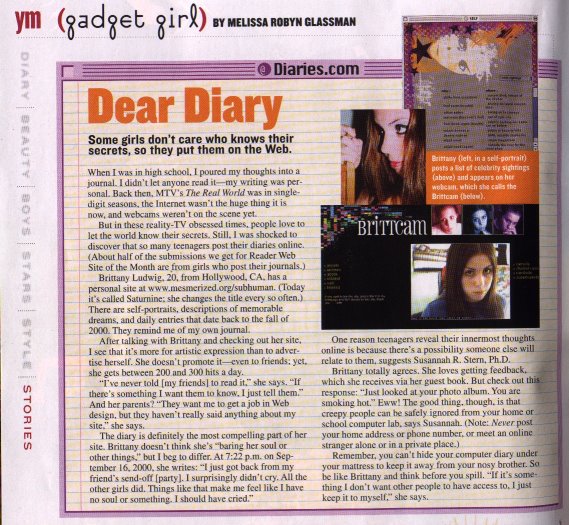
This image is an internet artifact about Everything/Nothing culture, cam culture, and cam girl culture (YM Magazine, publication information unknown). But, of course, this article only focuses on one aspect of the life style – the openness. I say “of course” here, because at that time it was a rather shocking thing to do – tell potential strangers and “fake” friends about your personal life on the internet. Facebook, however, has transformed that shock into a banal yawn. Nevertheless, this was at one point the moral panic for the parents and friends of a particular set of internet-people. Blogging was barely a thing. There were no content management systems you could just log into and make pretty and use easily. Writing about your life, openly and honestly, for a stranger to read about was a hugely subversive process. Luckily, the internet was at a point in its development where this attracted more like-minded individuals to each other than the serial killers from Lifetime Original Movies.
Liking the internet used to be a mark of shame. Having friends on the internet used to be worse – you could tell no one about it, you had to lie to other people about them, and people were concerned about your attachment to the non-reality of the computer. “My friend said something really funny today” to a meatspace human being would be a clever cover for “My friend updated their LiveJournal with a hilarious story.” Daring to meet that person was also something that required several lies. Why were you traveling to Indiana? How did you know this person? How were you friends with someone in Indiana? It took me years before I was comfortable with telling my parents I had met people off the internet, and that the majority of my now-real-life friends were from there. However, even if you were able to confess that you spent a lot of time on the internet, it was still impossible to admit that you were a blogger, or had a website, a journal, or a cam.
Continue reading Internet Culture – Everything / NothingOde to an .EXE –
The rise of music sharing isn’t a social calamity involving general lawlessness; nor it is the dawn of a new age of human kindness. It’s just new opportunities linked to old motives via the right incentives. When you get that right, you can change the way people interact with one another in fairly fundamental ways, and you can shape people’s behavior around things as simple as sharing music and as complex as civic engagement.
Clay Shirky, Cognitive Surplus: Creativity and Generosity in a Connected Age
(Originally Published Elsewhere: July 20th, 2013. I haven’t done any additional writing or put in any additional research into the relevance of some of my claims or updates from the companies in discussion. I think, however, a lot of this still stands on its own.)
Audiogalaxy doesn’t exist anymore. The website doesn’t take you anywhere. There is no 404. It is just dead. The official Facebook page is down – only Wikipedia links and fandom pages linger. It is not coming back.
Audiogalaxy has existed in different forms and iterations. Most recently, it functioned as a music streaming service. It was a way to stream your entire mp3 collection (and multiple other file formats) and playlists from a home computer through multiple devices. A small program was installed on your computer with all the music on it, and it streamed it to your smartphone or to any other computer by simply logging into your account on the AG website. Your collection stayed in one place and you could take it anywhere and everywhere. Logging into a website gave me access to the thousands of songs I loved. I didn’t need to install anything on an office computer, it didn’t upload my mp3 collection to a company’s cloud, there were no annoying or irrelevant ads, and it was completely ad free. It was, by and far, one of the greatest music-related programs I had ever encountered in my entire life. Its last day of functioning use was January 31, 2013.
Continue reading Ode to an .EXE –Review: Shudder exclusive “Lake of Death”
Lake of Death seems like an ambitious thriller, but ends up being this weird amalgamation of the worst parts of better movies. Narrative, tone, mood, themes are disjointed. relies on direct textual references to other movies to drive home tension, but also isn’t that sort of movie. The references don’t actually anything or go anywhere – they are a trick to artificially build tension that otherwise is lost by an underdeveloped story. It keeps name checking these other horrors in the dialogue, as if we are supposed to “get it” but works against those very references with its own cinematography. Which….could be interesting, if there was more development – either visually or narratively (but both fall short).
There are a few stunning shots and scenes of pure mood and they are generally cut off at the knee by the scenes directly following, rendered meaningless. This is cemented by some moody, late night shots that make the audience wonder about the main character – is she haunted, possessed by a secret trauma, is the cabin awakening something in her? But then there is a 10 minute scene about a potentially haunted breakfast table placement. Who made the dang breakfast???
The twist isn’t…really. You can see it coming a mile a way, as they telegraph it in the first 2 minutes. The movie works hard to make you think that there is MORE TO IT, but there really isn’t, at least not in a way that pays off. By act three, I stopped caring. This also might e a Norwegian thing, but everyone is painfully attractive in a way that makes me not care about anyone.
I always like to see the other comments on a Shudder movie, just to see what other people think. This is often somewhat dubious on my end, to see why other’s think something is good. I hate to break it to the user who didn’t “understand” the ending, but uh this is just yer classic, run of the mill, 9 to 5, meat and potatoes, lunchbox and thermos, traditional, fundamental, foundational, by the books Norwegian twin brother wants to fuck his sister movie. It is just propped up with a bunch of tropes to give the false allusion that it is something else, only to swing back at you with the painfully obvious twist that undercuts the previous developments of the movie.
Nothing to see here, folks.
My plan.
It isn’t original, or particularly interesting. I want to go back. I want to go back to the internet the way it used to be. The majority of my connection to the internet is controlled through global corporations with sketchy political connections, or just bad overall policy. I want to avoid all that as much as possible. The internet used to just be people blogging and connecting naturally. So, this is my attempt to do just that.
I will probably write about the media that I consume, in a critical context.
I will probably blog about my life.
Who really knows what else. This is a first post. There will hopefully be more to follow. I just need to write more.
 No Internet